Citizenship Song
As you continue to teach procedures and rules, try singing this song to promote positive behaviors and good classroom citizens.
(Tune: London Bridge)
In our class we follow rules
Follow rules, follow rules.
In our class we follow rules
Like good citizens.
We treat our friends with respect,
With respect, with respect.
We treat our friends with respect
Like good citizens.
In our class we wait our turn,
Wait our turn, wait our turn.
In our class we wait our turn
Like good citizens.
We keep our hands to ourselves
To oursleves, to ourselves.
We keep our hands to ourselves,
Like good citizens.
Taken from Mailbox Magazine (Aug/Sept 2009)

Thursday, September 8, 2011

Make and Take Monday
Sorry I have been out of commission. I have recently moved and my computer has been down.
I am trying to catch up for this week. Thanks for your patience.
Colorful Sensory Gel Bags
These bags can be added to your art area, discovery/science area, writing area, or even table toys ... practically anywhere. And the kids LOVE them!
Materials:
Hair gel (from the dollar store - clear or yellow)
Baggies
Food color (the food coloring in the tubes makes bright colors)
Clear packing tape
Trinkets (optional)
Directions:
1. Fill each Ziploc baggie with about 1/4 to 1/2 cup of hair gel. (The yellow hair gel works as well as the clear gel and it smells great!)
2. Add some food color to get the bright colors.
3. Add trinkets if desired.
4. Use clear packing tape to seal the top of the baggies.
TIP: To remove the Ziploc print from the baggie all you need is to lightly rub the white letters and symbols with a very little nail polish remover and a sponge and the white print will come right off.
I am trying to catch up for this week. Thanks for your patience.
Colorful Sensory Gel Bags
These bags can be added to your art area, discovery/science area, writing area, or even table toys ... practically anywhere. And the kids LOVE them!
Materials:
Hair gel (from the dollar store - clear or yellow)
Baggies
Food color (the food coloring in the tubes makes bright colors)
Clear packing tape
Trinkets (optional)
Directions:
1. Fill each Ziploc baggie with about 1/4 to 1/2 cup of hair gel. (The yellow hair gel works as well as the clear gel and it smells great!)
2. Add some food color to get the bright colors.
3. Add trinkets if desired.
4. Use clear packing tape to seal the top of the baggies.
TIP: To remove the Ziploc print from the baggie all you need is to lightly rub the white letters and symbols with a very little nail polish remover and a sponge and the white print will come right off.
 |
| Make a baggie with each color and place in the art area for children to explore. |
 |
| Add trinkets and add to your table toys area. Have children "squish" around and count the number of objects in the baggie. |
 |
| Add trinkets related to your current theme and add to your discovery area. For example, nuts, acorns, apples, etc. for fall. |
 |
| Use for small groups. Give each child a baggie and have them trace letters, shapes, numbers, etc. Photos taken from Teach Preschool |
Thursday, August 25, 2011
Thoughtful Thursday
Back to School: 10 Things to Consider
1. You need to know where your children are coming from, and where they are going, from a developmental standpoint. A developmental checklist used throughout the year is a great way to keep track of your students' development. You can create your own or use a commercial made checklist like Work Sampling System of Teaching Strategies GOLD.
2. You’ve heard the old phrase, “Start with the end in mind”. That’s just what you’ll be doing as you do some backwards planning, and create a yearly map. Consider where you want your children to be at the end of the year (your standards) and then work from there. How will you get them there? What activities and experiences will you plan?
3. Take a look at your room. Have you organized your learning areas? Use your interest areas to get the most from your room and give the most to your children.
4. Literacy is a major component of early education. What is your plan for language and literacy? Read to find out what research says about letter learning and language development. Consider how you will make literacy meaningful and relevant.
5. Consider how you plan to teach numeracy. There are plenty of ways to work it in throughout your classroom and curriculum naturally, not just through teacher directed activities.
6. It seems like a no-brainer. The children will arrive and they will eventually leave. But have you given much thought to the procedure? Establishing well-thought out arrival/departure procedures can make or break your day.
7. Establish as part of your daily procedures a sign in procedure. Children will improve in name recognition and writing, as well as recognizing others’ names and finding shared letters. It’s a fantastic tool for teaching writing and letter recognition while taking attendance at the same time!
8. Communication between parents and teachers is critical. Consider ways to make sure information gets to where it’s supposed to go, i.e folders, journals, agendas, etc!
9. Have a Parent Meeting to get your parents on board! Share your curriculum and philosphy of teaching and learning. Answer those questions up front for an easy transition.
10. And saving the best for last, make sure you take the time to get to know your children and develop those important routines and procedures. Taking the time at the beginning will pay off in the end! And also take time for yourself and your family!!
1. You need to know where your children are coming from, and where they are going, from a developmental standpoint. A developmental checklist used throughout the year is a great way to keep track of your students' development. You can create your own or use a commercial made checklist like Work Sampling System of Teaching Strategies GOLD.
2. You’ve heard the old phrase, “Start with the end in mind”. That’s just what you’ll be doing as you do some backwards planning, and create a yearly map. Consider where you want your children to be at the end of the year (your standards) and then work from there. How will you get them there? What activities and experiences will you plan?
3. Take a look at your room. Have you organized your learning areas? Use your interest areas to get the most from your room and give the most to your children.
4. Literacy is a major component of early education. What is your plan for language and literacy? Read to find out what research says about letter learning and language development. Consider how you will make literacy meaningful and relevant.
5. Consider how you plan to teach numeracy. There are plenty of ways to work it in throughout your classroom and curriculum naturally, not just through teacher directed activities.
6. It seems like a no-brainer. The children will arrive and they will eventually leave. But have you given much thought to the procedure? Establishing well-thought out arrival/departure procedures can make or break your day.
7. Establish as part of your daily procedures a sign in procedure. Children will improve in name recognition and writing, as well as recognizing others’ names and finding shared letters. It’s a fantastic tool for teaching writing and letter recognition while taking attendance at the same time!
8. Communication between parents and teachers is critical. Consider ways to make sure information gets to where it’s supposed to go, i.e folders, journals, agendas, etc!
9. Have a Parent Meeting to get your parents on board! Share your curriculum and philosphy of teaching and learning. Answer those questions up front for an easy transition.
10. And saving the best for last, make sure you take the time to get to know your children and develop those important routines and procedures. Taking the time at the beginning will pay off in the end! And also take time for yourself and your family!!
Wednesday, August 24, 2011
Workshop Wednesday
Name Game
Directions:
Play this little concentration game to help your children recognize their own name and the names of their classmates.
Directions:

- Print each child’s name (upper and lower case) on a two separate sentence strips.
- Cut one name apart leaving one letter of each child’s name on a card.
- Mix all the letter cards of each child’s name that is participating.
- Turn all the letter cards over in the center of the table.
- Have the children place their name card in front of them.
- Each child takes a turn drawing a card.

- If the card they turn over is a letter in his or her name then they keep the card and put it on or under their name card.
- Keep playing until everyone has found the letters in their name.

 |
| Taken from Teach Preschool |
Tuesday, August 23, 2011
Transition Tuesday
It's the beginning of the year and you are probably spending every minute of every day teaching routines and procedures. One routine is that of transitions. Transitioning from one activity to another is very difficult for young children. They need help making transitions. You can teach simple signals, songs, games, etc. to help the transition process. Below is a song to teach children when you want them to sit on the carpet or rug for group time.
Have a Seat
(tune of “Shortnin’ Bread”)
Everybody have a seat, have a seat, have a seat.
Everybody have a seat on the floor.
Not on the ceiling, not on the door.
Everybody have a seat on the floor!
Taken form Dr. Jean
Monday, August 22, 2011
Make & Take Monday
Welcome Back!
It's beginning to look a lot like SCHOOL. It is hard to believe another school year has started. Time flies. Our first make & take is a great sensory idea (wouldn't you know it!) It is a back-to-school tub. Hope your kids enjoy!
Materials:
:: Shredded notebook paper (or shredded construction paper)
:: Pencil case (one with a zipper will encourage fine motor development)
:: Crayons (homemade crayons would be fun too):: Pencils
:: Erasers (which can be added to the pencil tops for a fine motor activity)
:: Pencil sharpener (to be used with the pencils, of course)
:: Scissors (children can further cut the shredded paper)
:: Paper clips (these can be used to make chains, patterns, counting, etc.)
:: Wooden alphabet tiles
It's beginning to look a lot like SCHOOL. It is hard to believe another school year has started. Time flies. Our first make & take is a great sensory idea (wouldn't you know it!) It is a back-to-school tub. Hope your kids enjoy!
Materials:
:: Shredded notebook paper (or shredded construction paper)
:: Pencil case (one with a zipper will encourage fine motor development)
:: Crayons (homemade crayons would be fun too):: Pencils
:: Erasers (which can be added to the pencil tops for a fine motor activity)
:: Pencil sharpener (to be used with the pencils, of course)
:: Scissors (children can further cut the shredded paper)
:: Paper clips (these can be used to make chains, patterns, counting, etc.)
:: Wooden alphabet tiles
 |
| Taken from Counting Coconuts |
:: Number beads, 0-10 (can be laced)
:: Tiny wooden apples
:: Tiny wooden apples
:: Colorful shapes
:: Mini homemade notebooks
:: Mini homemade notebooks
:: Small alphabet book
:: School bus calendar cards
:: Back to school novelty buttons
:: School bus calendar cards
:: Back to school novelty buttons
Monday, June 6, 2011
Make & Take Monday
I apologize for not posting last week - - - technical difficulties. This will be my last week until after the summer. I am ready for a much needed vacation. Hope you enjoy your summer too!
SUMMER WRITING (OR READING) KIT
SUMMER WRITING (OR READING) KIT
A personalized writing or reading kit will keep supplies in one place and inspire kids to write and read wherever summer adventures take them!
Materials: favorite fun reading and writing materials like:
- markers, crayons, pens,
- paper
- stickers
- envelopes
- post-it notes, tiny note pads (or small stapled booklets of blank paper)
- mini-flashlights
- clipboard
- cereal box decorated with catalogue/magazine clippings
Directions:
1. Cut the cereal box at an angle and then decorate it with clippings from catalogues and magazines.
2. Add an assortment of reading and writing materials.
3. For the container, use: a giant Ziploc bag, cloth bags, blank aluminum lunchboxes, a pencil box
4. For the writing kit, use: ‘special’ summer writing paper, various sizes of paper, colorful post-its, glittery pencils and pens, postcards, poetry objects, etc.
5. For the reading kit, use: books written by the child, special book marks with reading reminders.
2. Add an assortment of reading and writing materials.
3. For the container, use: a giant Ziploc bag, cloth bags, blank aluminum lunchboxes, a pencil box
4. For the writing kit, use: ‘special’ summer writing paper, various sizes of paper, colorful post-its, glittery pencils and pens, postcards, poetry objects, etc.
5. For the reading kit, use: books written by the child, special book marks with reading reminders.
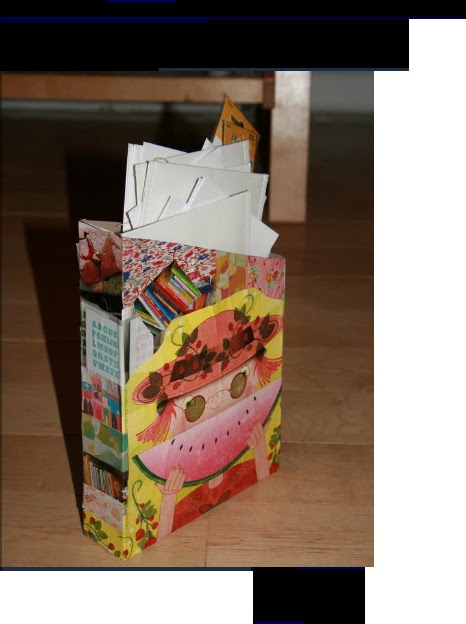 |
| Taken from Tiny Reader |
Subscribe to:
Posts (Atom)