Powered By Blogger
"The secret of good teaching is to regard the child's intelligence as a fertile field in which seeds may be sown, to grow under the heat of flaming imagination."

--Dr. Maria Montessori


Friday, December 2, 2011

Feature Friday

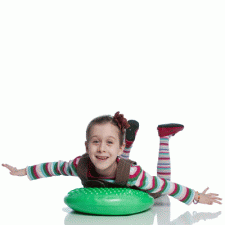
green therapy cushion

Tactile Inflatable Cushions

Have you ever had a student who just couldn’t seem to sit still no matter what? Then try these new tactile cushions from Fun and Function. Children who have the wiggles can easily find their place with Tactile Inflatable Cushions! Wonderful for balance and posture. Increase or decrease the air for the perfect seating arrangement. Features a smooth surface on one side and smooth slightly raised “bumps” on the other. The Tactile Inflatable Cushion is an ideal choice for children with sensory processing and focus challenges as it allows just the right amount of movement without leaving their chair. Movement can create a filter from over stimulation and encourage focused attention. So why sit still when you can move and learn!

magic cushion fun and functionThe cushions come in a variety of shapes, sizes and colors. They are made of a very thick, durable vinyl material. The cost is $24.99.

Consumers testify that they really work! Yes, can you believe it? Something that really does what it says it does, how cool is that? Second, you may want to purchase more than one cushion. If possible, have several and make sure the children who really need them get them, but rotate the other cushions among the other students to balance things out. And third, they hold up really well which is a huge relief when working with young children.

I don’t know about you but I’m sold on these therapy cushions!


Thursday, December 1, 2011

Thoughtful Thursday

Is There Danger in Play or More in its Absence? Part 1

As parents and caregivers, the safety of our children is our highest priority.  We ask them to wear their helmets while biking, to look before they leap, and we remind them again and again of the proper procedures for crossing the street.  We want them to be safe.  That’s reasonable and responsible.  But, as it is easy to do, we sometimes go a bit overboard on our efforts to protect our children.  In the long run, some of our efforts can backfire.

Can A Playground Be Too Safe?

A piece in the New York Times, entitled, “Can a Playground Be Too Safe?”,  the author notes that the tall slides and adventurous climbing structures of our own childhood playgrounds have been replace by tamer, assumably more lawsuit-proof equipment.  While anyone with memories of asphalt-gnarled elbows or sunny-slide-burned thighs might be grateful for the progress, some researchers question if we’ve taken our safety measures too far, removing the opportunity for valuable play experiences.

Author of Last Child in the Woods, Richard Louv, cites that many parents keep children away from playing and exploring outdoors because they’re afraid of kidnappers, serial killers, and other crazies and kooks.  Unfortunately, too many children are harmed by adults, but the majority of those incidents involve family members, not strangers.  In fact, while our 24-hour news cycle makes us aware of every misdeed around the world, the truth of the matter is that, according to crime statistics, it’s actually safer for children to play outside than it was during many of our own childhoods.

Play Spaces and Play Time Are Slowly Disappearing:  At What Cost?

Between our fear of strangers and injuries, our acceptance of push-down academic goals, and our society’s penchant for litigation, play spaces and play time are slowly disappearing from the lives of many children.  What is the cost of this trend?

In The American Journal of Play, research professor and prolific writer, Peter Gray compares research showing that the decrease of play in America seems to correlate with an increase of anxiety, depression, and other types of psychopathology.  It’s a connection that Gray strengthens with decades worth of research.

While research shows that child-led play is being replaced by school work, TV and computer time, and organized sports activities, concurrent studies also show an increase in psychopathology in children and adolescents.  These mental ills include things like anxiety, depression, and even narcissism.  While checking for other causes of psychopathology, this research found that American children are actually more anxious now than they were during the Great Depression, World War II, and the cold war.

Posted by Angélica Pérez-Litwin in HOME LIFE, Parenting
Contributing Author - Amanda Morgan

Wednesday, November 30, 2011

Workshop Wednesday

Chocolate Bells-Sticker Matching

Materials: Christmas candy - chocolate bells or "kisses"; dot stickers or Christmas stickers; permanent marker

Directions: Write or draw shapes, numbers, letters, etc. on the stickers and place on the bottom of each candy bell/kiss.  Lay the candy bells in several rows. Have the children turn one bell/kiss over at a time and then look for the match.

Children will LOVE playing with the candy.  But the most fun is eating the bells! Yummy!


Photo taken from Little Family Fun


Tuesday, November 29, 2011

Transition Tuesday

Christmas Presents
See all the presents by the Christmas tree. (Hands in sweeping motion.)
Some for you (Point to children.)
And some for me. (Point to self.)
Long ones, (Hands spread wide apart.)
Tall ones, (Measure from the floor.)
Short ones, too. (Hands close together.)
And here is a round one (Make circle with arms.)
Wrapped in blue.
Isn't it fun to look and see
All the presents by the Christmas tree? (Nod.)

Monday, November 28, 2011

Make & Take Monday

Lacing Jingle Bells

Materials: bells (different colors) and stiff string

Directions: Have children lace the bells on the string. You could extend it the activity by including pattern cards. For example, make pattern cards using colored dots or pictures of colored bells - red, green, red, green or blue, silver, blue, silver. Children choose a pattern card and make the pattern by lacing the bells on the string. You could also have the children roll a die or draw a number card and lace that many bells on the string.  With or without specific directions children will enjoy lacing and ringing the bells!

Photo taken from Counting Coconuts

Friday, November 11, 2011

Feature Friday

Flip Video

What is a Flip Video camera? A Flip Video is a small, inexpensive digital camcamcorder.  It’s about the size of a regular digital camera and can easily fit in your pocket.
What makes the Flip Video camera so special?
The Flip Video has several unique features that make it very attractive to educators:
  • It’s very inexpensive, about $130- $150 for the basic models.
  • The Flip Video is extremely easy to use.
  • The quality of the video is fantastic for such an inexpensive and simple camera, both audio and video are exceptional.
  • No cables! The camera hooks up to your computer with an attached USB port to upload videos directly.
  • No fancy batteries, the Flip takes 2 AA batteries.
  • No tapes to mess with- the camera stores all video digitally on the internal hard drive.
  • No complicated buttons, to turn on the Flip you just push the big red button! There are no complicated switches and buttons to navigate, it’s super easy.
How can I use a Flip Video camera in my classroom?
The possibilities for using the Flip Video in the classroom are really endless and you are only limited by your imagination, but here are a few ideas to inspire you:
  • Digital Storytelling
  • Record students acting out a story such as The Three Little Pigs
  • School tours for new students
  • Recording daily activities in the classroom then showing the video to parents at open houses to demonstrate student learning.
  • Tape a model lesson to show to new teachers.
  • Record field trips so you can extend learning after the field trip is over.
  • Video student portfolios: Use the Flip to record evidence of student learning. Create a digital video portfolio for each student.
  • Behavior: If you have a behavioral problem videotape the behavior and review it with parents and administrators to discuss a course of action. Since the Flip is so small and easy to use you can just pull it out and start recording with the touch of one button- no set-up necessary.
  • Science experiments: Record science experiments to extend learning.
  • English Language Learners: Record students narrating a story, a personal narrative or fictional story like a fairy tale.
Taken from Pre-K Pages

Thursday, November 10, 2011

Thoughtful Thursday

Below is a GREAT article written by Amanda Morgan on the value of play and its role in academics. It's a little long but it;s well worth the read.

Play vs Academics: A False Dichotomy

An argument is brewing in the preschool scene. In one corner, you have those arguing for more academics to give children that head start that might correct the troubles of high-school drop-outs and low test scores. They claim that children rise to the occasion and show that they are capable of more than we’ve been asking.
In the other corner, you’ll find those who say play is disappearing from the cultural landscape of America and that its absence is a contributor to many childhood maladies such as obesity, ADHD, and declining social skills. They say that children “rising to the occasion” are really only performing splinter skills, which are more closely aligned with party tricks than with actual learning.
Certainly, both camps can make compelling arguments. But each time I read an article giving voice to the two sides, I find myself thinking: these aren’t mutually exclusive points of view. The notion that a child’s education can either be playful or academic seems to be creating an unfortunate and false dichotomy.
It seems to me that setting play and academics at odds with each other is pitting the method against the goal. It’s not an either/or choice, it’s a means and an end.
The term “academic” has come to mean “formal, direct instruction”, and in that sense, the two modes are different. But when “academic” is viewed as scholarly and giving rise to study and learning, it easily goes hand in hand with a play-based education structure.
To be sure, often the two camps are really at odds over what expectations are developmentally appropriate. But if we’re talking about developmentally appropriate learning outcomes, truly, academics can be taught and learned through a play-based curriculum. In fact, in many ways, I believe that the format of play and experience can teach and prepare young children for concepts that are more advanced than could be taught in a formal, conventional way. Here’s an example.
You would (hopefully) never consider plopping a multiplication worksheet down in front of a preschooler, followed by an explanation of the basic principles and procedures of algebra. However, I know a phenomenal preschool teacher who recently gave her students a similar challenge, but in an authentic, playful way.
As this teacher sat down to snack with a group of her students, she noted that there were five people at the table and each person could have 3 crackers. She then asked the children at the table how many crackers she should put on the plate to serve. One child enthusiastically answered, “Three!” So the teacher placed three crackers on the plate and set it on the table. The children looked around at five hungry faces, trying to figure out where they went wrong. As the gears turned in their minds, one child suddenly shouted, “Fifteen! We need fifteen!” Not bad for a “non-academic” school.
A quality play-based learning environment is not just a glorified birthday party. Each activity, each nook and cranny, and every loose part is arranged and made available with specific developmental objectives in mind. Ask a teacher and he or she will be able to tell you, “That builds fine motor skills for writing. That promotes sorting, which is the basis of the set theory of mathematics. This will help with phonological awareness, which leads to literacy. Here we invite creativity and problem-solving while over there they are using their language and interpersonal skills.”
It’s those foundational experiences that allow children to learn advanced concepts more easily and more thoroughly. I worry that in our effort to get ahead in education, we’re simply skipping these foundational pieces so often learned through play. It’s like being in a rush to construct a tall building, so we decide to forget about the foundation (nobody really sees that anyway) and jump right to the first floor. It might look OK at first, but eventually we get to the second or third floor and suddenly we realize that things aren’t solid, and we find ourselves slipping. I really think many of the academic problems we see in primary grades are not because the children didn’t start formal instruction early enough, but because they don’t have enough foundational experience for that formal instruction to make any lasting connections.
I guess what bothers me most is that setting play and academics at odds with each other often implies that one is for feel-good fun and the other is for real learning. That one is just daycare and the other is school. In reality, a play-based education is not only more responsive and developmentally appropriate for young children, but it also teaches them not only how to answer, but how to think. Not just to recite, but to inquire. Not simply to complete worksheets, but to build connections. Academic content isn’t just taught, it’s meaningfully constructed.